





ARALIK
Interactive Art Installation
Project Team:
Designers: Ayşegül Akçay Kavakoğlu, Bengü Özmutlu
Advisors: Seden Acun Özgünler, Batuhan Esirger
Exhibition Setup Asistant: Mazlum Özkoç
Date: 2025
Exhibition: International Architecture Biennial of Antalya
Location: Antalya, Türkiye
Materials: Tulle Fabric, Aluminium, wood plate
Tools for design & fabrication: Drone, Rhinoceros, Touch Designer, Adobe After Effects
Tools for projection mapping: Touchdesigner
Sponsor: Ersaş Systems
Size: 2.40m x 2.40m x 2.20m
Aralık is an architectural installation that creates interactive cultural heritage experiences through artificial intelligence. Within the scope of the International Architecture Biennial of Antalya, it explores the use of artificial intelligence in design, sustainability, and the permeability of social and spatial boundaries. While "Aralık" questions the contribution of AI to the sustainability of cultural heritage in public spaces, it also opens a gate towards new means of interaction in public spaces. The Turkish word "Aralık" means interval in English. The word "aralık" is generally defined in dictionaries as "the distance between two things, an opening, a gap…, a narrow passage," while in music, it is defined as "the distance separating one sound from another…," and in mathematics, as "all the numbers between a beginning and an end…." However, the definition of "interval" can also be interpreted metaphorically.


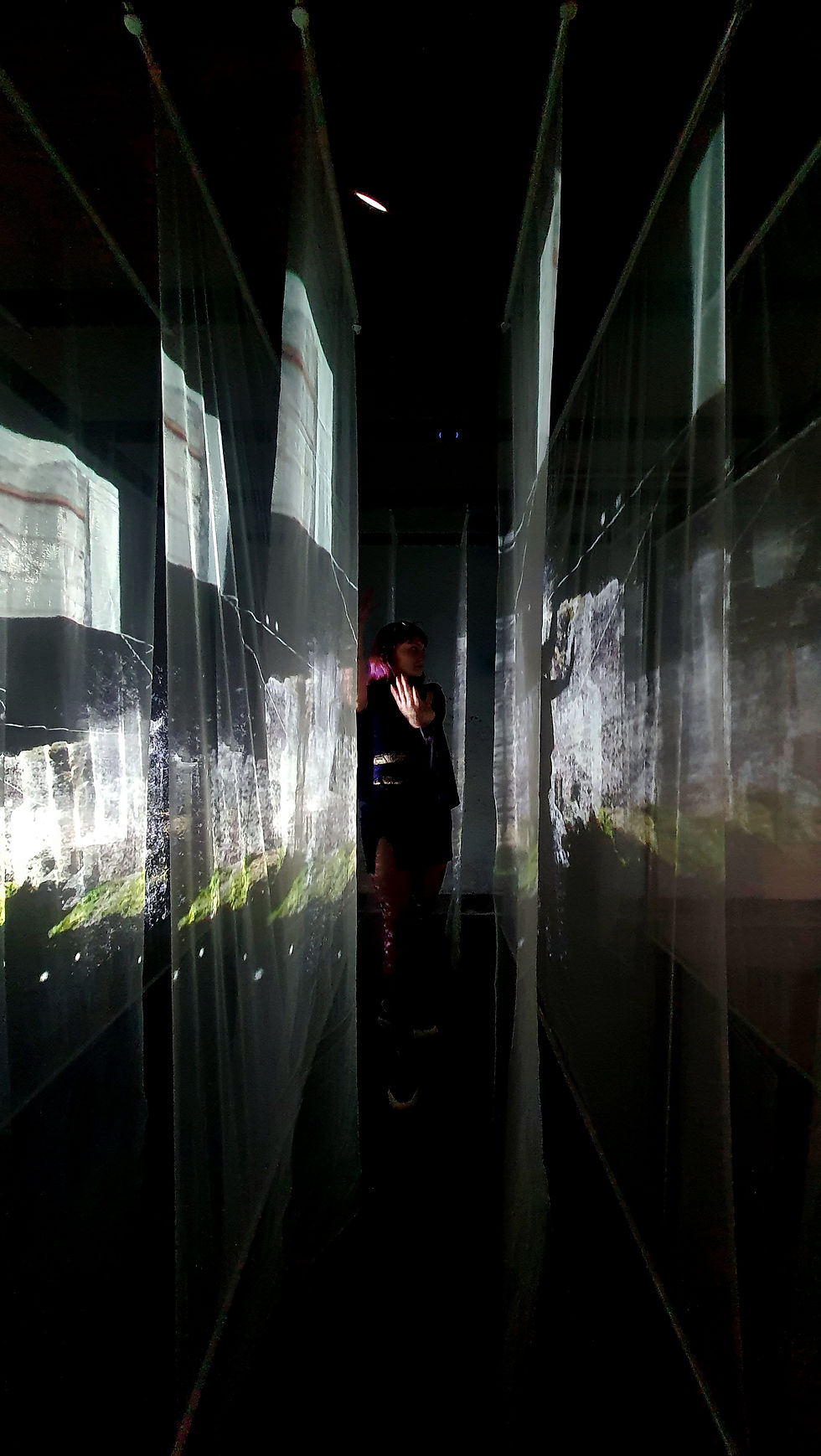


The installation Aralık presents the viewer with a spatial representation of a multilayered architectural memory through projection mapping, focusing on the tectonics of the Mevlevihane (Mevlana) Gate of the Istanbul Land Walls having layers from the Byzantine and Ottoman periods to the modern era. Istanbul Land Walls were listed as the UNESCO World Heritage List Site in 1985. The wall structure, constructed in different periods in different architectural styles, construction techniques, and materials, is considered a spatial and temporal interval. In this context, the concept of interval represents the transformations, changes and threshold states of cultural heritage within continuity rather than a gap. The palimpsest gate and the Aralık are situated precisely within this state of plural temporality. It belongs neither entirely to a single time, nor to a single community or to a single culture. This intermediary position is conceptualized both as a physical interface and a transitional zone within cultural memory.
While the installation aims to raise public awareness of the trio of cultural heritage, AI, and architecture, it has also been used in an educational context alongside its artistic and scientific content. Aralık, besides being a work of art, was also discussed as a case study in the "AI-driven Speculative Interactions: Towards the Wall" workshop, held as part of the ITU Erasmus+ Blended Intensive Program titled Augmented Thresholds:Sustaining Architectural Heritage of Istanbul Land Walls project in July 2025, due to the methodology it presents. The 3D-scanned data used during installation and workshop was captured at the beginning of the Augmented Thresholds BIP Project. The whole methodology of the Aralık installation was shared with the workshop participants. The workshop explored how future public interactions will generate new ways of experiencing cultural heritage and how we can create new forms of interaction through AI. Scientific sources and consultant support were used to classify the historical context of the building materials of the İstanbul Land-walls .


